
Operator Library: Hardware Platform
此算子表示通过 QSFP28 光纤端口的逻辑数据接收链路。该链路使用所选端口内的特定光纤通道,并在输出 O 上从另一个图像采集卡接收数据。RX PHY 的状态在输出 LinkUp 上提供。
DFRxData 算子仅在 AppletProperties 算子中的 FiberProtocol0 和 FiberProtocol1 参数设置为 DataForwarding 时才能使用。如果在 AppletProperties 算子中的 FiberProtocol0 和 FiberProtocol1 参数设置为 CoF,设计规则检查 (DRC) 会提供一条错误消息,并且 DFRxData 算子的使用将被阻止。
该算子可在 QSFP28 端口内使用 1 到 4 个通道来接收数据。这种灵活性允许针对不同场景优化端口使用。因此,单个 QSFP28 端口可由以下配置中的多个 DFRxData 算子共享:
-
1 个 x4 算子
-
2 个 x2 算子
-
1 个 x2 算子外加 2 个 x1 算子
-
1 个 x3 算子外加 1 个 x1 算子
-
4 个 x1 算子
QSFP28 光纤端口提供的总带宽为 100 Gbit/s,均分在四个通道上。每个通道的运行速度为 25 Gbit/s。根据配置的不同,算子的运行速度如下:
-
x4 通道:100 Gbit/s
-
x3 通道:75 Gbit/s
-
x2 通道:50 Gbit/s
-
x1 通道:25 Gbit/s
该算子可以与 DFRxMeta 算子共享其分配的通道,而不会产生任何冲突。但是,不允许在多个 DFRxData 算子之间共享通道。
DFRxData 算子不需要特殊协议。它用作两个图像采集卡之间逻辑链路的端点:DFTxData(源,图像采集卡 1)和 DFRxData(宿,图像采集卡 2)。两侧的链路设置必须完全相同,包括 QSFP28 端口和通道配置。此外,VisualApplets 链路协议必须在两端匹配。它是 VALT_IMAGE2D 或 VALT_IMAGE1D。
可以通过后续算子暂停 DFRxData 算子上的数据接收。在暂停期间,不会丢失任何数据;暂停信号会传播到发送方,并且传输方会停止发送。当阻塞算子解除对 DFRxData 链路的禁止时,传输将正常恢复。数据流水线包含用于处理临时暂停的缓冲区:
-
接收端 (RX):大缓冲区(1024 个条目),用于吸收短暂的接收阻塞而不停止传输。
-
发送端 (TX):小缓冲区(64 个条目),用于处理简短的元数据传输而不中断发送。
有关数据转发的更多详细信息,请参阅 'Data Forwarding with imaFlex 2 Dual 100 Frame Grabbers'。
| 适用于 Hardware Platform |
|---|
| imaFlex 2 Dual 100 |
资源
该算子将 FiberConnection 参数设置镜像到 对话框中作为只读参数。如果您从 菜单打开 对话框,则可以查看 FPGA 设备资源。设备资源是只读的:
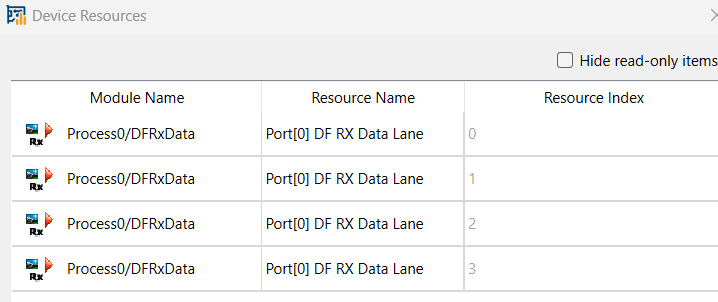
根据所分配的端口,该资源属于 Port[0] DF RX Data Lane 类型或索引范围从 0 到 3 的 Port[1] DF RX Data Lane 类型。该算子分配的通道数量取决于其配置:
-
x4:使用 QSFP28 端口的所有 4 个通道
-
x3:使用 3 个通道
-
x2:使用 2 个通道
-
x1:使用 1 个通道

O 链路将接收到的数据传输至 VisualApplets。LinkUp 链路指示连接状态:当 LinkUp 处于活动状态时,配对的 TX 端和 RX 端均已准备好传输和接收数据,这意味着链路已完成训练并处于运行状态。
|
|
Parallelism 由 FiberConnection 参数决定。它等于正在使用的光纤通道数量。 |
| FiberConnection | |
|---|---|
| 键入 | 静态写入参数 |
| 默认 | port_0_lane_0_1_2_3 |
| 范围 | {port_0_lane_0_1_2_3, port_0_lane_0_1_2, port_0_lane_0_1, port_0_lane_2_3, port_0_lane_0, port_0_lane_1, port_0_lane_2, port_0_lane_3, port_1_lane_0_1_2_3, port_1_lane_0_1_2, port_1_lane_0_1, port_1_lane_2_3, port_1_lane_0, port_1_lane_1, port_1_lane_2, port_1_lane_3} |
|
此参数用于指定 DFRxData 算子接收数据所使用的 QSFP28 光纤端口和通道。 只有将该端口对应的 AppletProperties 算子中的 FiberProtocol 参数设置为 DataForwarding 而不是 CoF 时,才能使用所选的 QSFP28 端口。 如果 FiberProtocol 设置为 CoF 并且 DFRxData 算子尝试映射到该光纤端口,则设计规则检查 (DRC) 将生成错误消息。在这种情况下,FiberConnection 参数将被标记为冲突(红色),将鼠标悬停在上面将显示解释冲突的快速提示帮助消息。 在同一通道上,只有一个 DFRxData 算子可以使用相同的硬件 QSFP28 端口。多个算子之间的映射在整个设计中必须是唯一的。 |
|
以下示例展示了 DFRxData 算子的使用方法:
-
这些示例展示了如何在 imaFlex 2 Dual 100 平台上实现数据转发。
 上一页
上一页

